Pip: There’s a building somewhere in the future with three domes, a spire, piped-in oxygen, and a globe that lights up every time a baby is born. Dr. Jen Wyman-Clemons, MD has been thinking again.
Mara: This episode follows a single vision — a concept called the Oxygen Palace, what it’s built from, what it’s built for, and what it quietly asks of the people who walk through it.
Pip: Let’s start with the palace itself.
Oxygen Palace
Mara: The Oxygen Palace is a proposed space — part wellness center, part civic symbol — designed around the literal and figurative idea that fresh air is something you can architect. The central question the post poses is: what does a place look like when its entire purpose is to restore the people inside it?
Pip: The post opens with exactly that premise: “Oxygen palace is where your soma feels uplifted — even resurrected afterwards. A place where fresh ideas might reach you.”
Mara: Soma is the body, the whole physical self — so the claim here is that the space works on you at a physiological level, not just as atmosphere. Oxygen is piped in to supercharge the environment, plants provide what the post calls their natural medicine, and the rest, as the post puts it, is love and light.
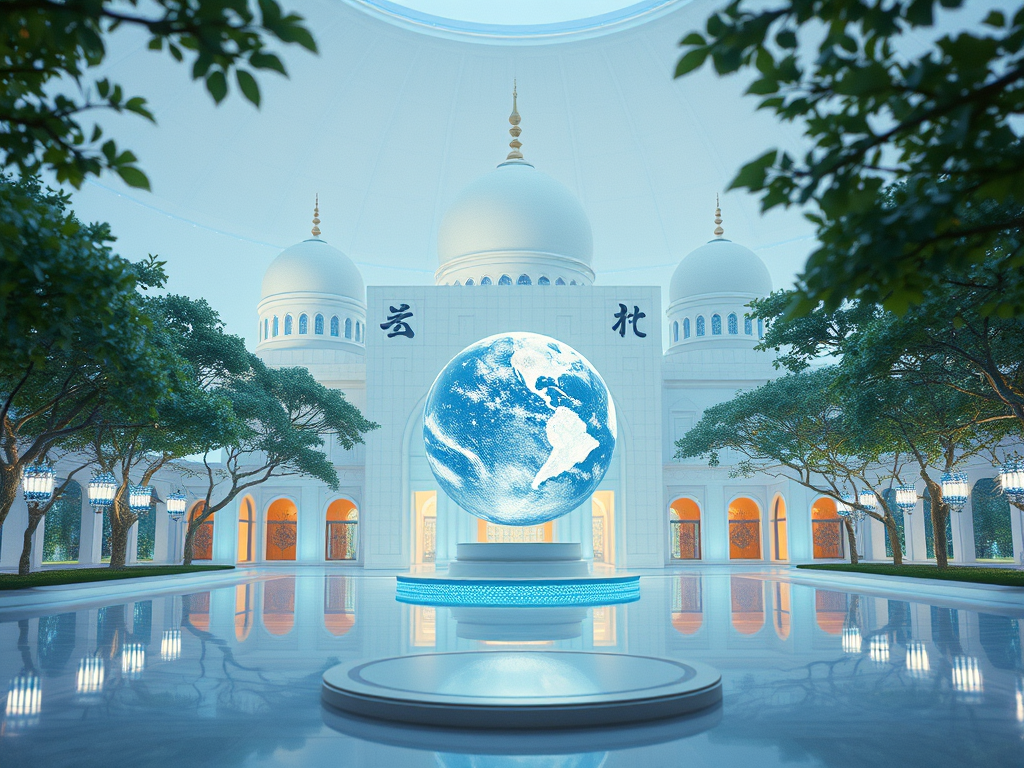
Pip: A white building with three domes or a spire, outlined in crystal blues with black calligraphy, surrounded by a tree grove. It’s a surprisingly specific blueprint for something that also contains a disco ball snowflake ceiling.
Mara: The snowflakes are worth pausing on. They’re handmade, each different, suspended at different heights, and the post is precise about why the pace matters: “One must slow to keep the snowflakes from becoming too tangled and wildly twirling. They aren’t pretty that way.” The architecture is literally enforcing stillness.
Pip: That’s the design principle hiding inside the decoration — the space teaches you how to move through it by what breaks if you don’t.
Mara: The atrium holds a turning globe that lights up from a continent’s economic centers each time a baby is born. The post reads that as a reminder that every new person is, in its words, a one-in-a-million star and a future producer for their land. Africa gets a specific mention, framed as the land of first fathers and as an ongoing study in how division limits opportunity.
Pip: There’s also a hall of mirrors, a bubble station, a yodeling area where AI reflects your own voice back after a pause, a temple of aurora, a library of new writing, and a cafe serving Shirley Temples and teacake. The post is building an entire interior world.
Mara: And it’s staffed by what the post calls a maiden — someone untouched by outside worry, which it suggests could be a teenager, or equally a crone, someone unafraid of their own truth. Visitors change into simple shifts and closed-toed sandals but keep their coats, because the ambient warmth of the space, the post notes, is enough that coats end up flung open by the end anyway.
Pip: The yodeling area is the one that stays with me — your own voice, returned to you after a delay, as a reminder that it’s the thing most likely to rob you of fresh air.
Mara: The post closes on that idea of release: bubbles that don’t burst so much as thin and evaporate, dreams lofted and finally let go. The whole space is oriented toward that — coming in gray, leaving energized, and the post is clear: no hangovers, no residue.
Mara: The Oxygen Palace is ultimately a philosophy with a floor plan — restoration as something you can walk through, slow down inside, and leave changed.
Pip: Next time, we’ll see what other architecture the mind builds when it’s had enough fresh air to think clearly.
Here’s a link to the essay!