
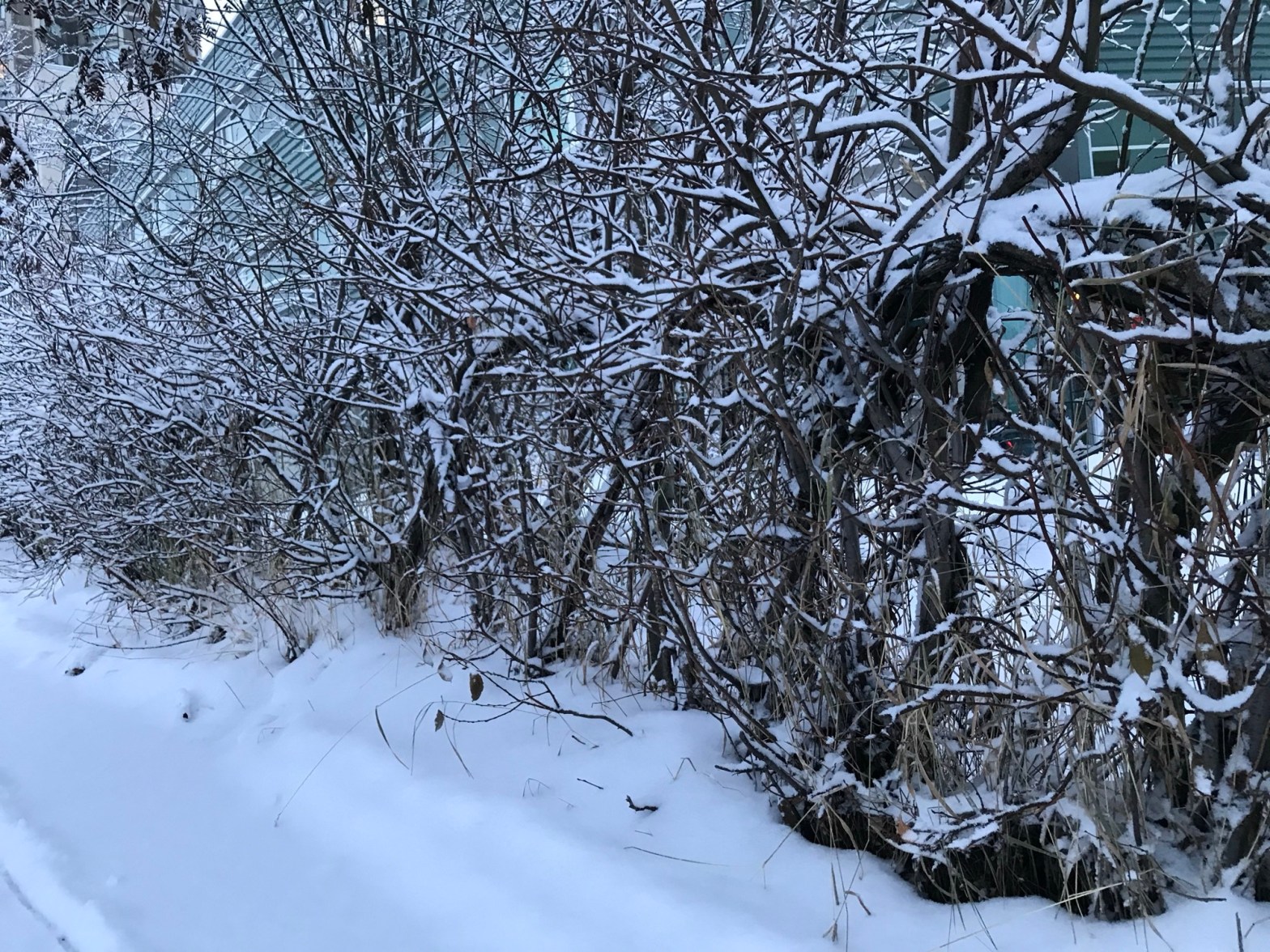
{Fallen Snow}
When the snow has stopped falling, one’s world is covered in a blanket of white. Even a dusting is like magic. With everything evenly coated, all is sparkling and “clean”. Or, so it seems. Early after a storm, I love snows somber quietude so I try to get out in it early. Then there’s ~perfect coating on buildings, streets, and sidewalks. All is crystal white glittering before others go out and trample it.
Fixed beliefs , like “snow” only ‘melts’, becomes deconstructed, when the sun (a ~blinding teacher or leader) comes out or with salt -tangible grounded direct experience and the environment isn’t frigid but leaves a gritty pith of new surface layer.
I fell in love with snow the minute that I saw it- around age two or three when snow on the walkway was piled higher than my chest and shoulders. From then on, when it snowed outside, mom couldn’t keep me inside.
Then I also learned to love my layers- since I always got swollen pink itchy spots on my hands and feet after being outside. Lucky for me, they didn’t and don’t last too long.
[Dress properly for your conditions and wear your mittens.]
When a few inches have collected, at least for a moment, there’s a glimpse of what ~equality looks like. But this isn’t the quality of clarity and individuality, it’s the equality of being snowed and confused – more a world immersed in folie a deux.
Then fall’s sepia monochrome (and litter’s barrenness) is gone- all is temporarily coated with whitewash.
Snow smooths out differences between structures and brings uniformity to the plain.
After snow has fallen and collected, streets, cars, walkways and buildings each have their ‘story’ minimized. Ugliness and harsh lines are masked- which is alas, all too prevalent. It is all too easy otherwise to focus on other’s freakishness.
With snow’s cessation, yes rest without so many distractions. After a big dump, complicated structures become formless bumps. When thick snow sets on them, you can barely tell which is which. They get snowed in. It can take days for them to regain visibility.
(Hearing a great lecture or teaching can leave us with our mind focused on it for a while- so we aren’t so obsessed with life’s otherwise small details.)
Flat or curved, each structure collects snow in a special way. Tall and slim, or wide with branches, snow, like opportunity, is received by each differently. How it lands, depends on the surface. Later when the sun returns, spire beings stand in sharp relief. (They don’t ‘get’ it) They hold little snow and stand austerely- unlike those less defined structures, and students.
Even though it seems snow’s precipitation is the same everywhere, each building has their own microclimate(s) affecting snow piles’ distribution.
Some have areas where wind is funneled; in others is blocked, leading to differences in local accumulation.
[Like a teacher’s words address an entire class – they are received individually.]
Snow smooths most- but not all- spires still stand out. They don’t collect snow. They have no ‘cup’ shape to collect with other than their crowns,. They wave snow off quickly. Their being stands out because of their barrenness and they build up no history of collections.
Such is what happens when you put someone into a situation they don’t resonate with – they stay standoffish – because they are!
*
{Portals of Light}
Each house, blanketed in white, differs like fingerprints with their window portals. Looking out over a snowy landscape, houses twinkle- suggesting coziness; realities may be different.
No one of them is the same- even row houses and condominiums. No one is identical inside or out, though they might seem so at a glance. Stuff on a balcony belie the individual. Do they love plants, even if they have no garden available? Then you’ll see an overlook with plants on it. Or are they more into fancy bikes and barbecues? Each one has its own flavor.
Individual haven’s window portals differ. None are identical inside or out, though they might seem so at a glance. You might only appreciate these differences if you were inside visiting- and then only if the inhabitants were relaxed.
Look more closely, even a “cookie cutter” house, has differences in its windows and dressings. The drapes[ Drapes block out light and wind – so also decrease the amount of light that sheds on the interior and changes from outside. Winds are as ideas driven by passions which stir us.] are all little bit different. Some pulled back, others pulled shut, with different hues and materials.
Choices of lighting differ; though most but not all flicker with electric blues.
Each collective of “home” represents a different entity of hu(e)-man.
Overall the effect, can be quite cheery! I love harmonious diversity. There’s a gentle form of chaos. It is healthy and reassuring at the same time that no one is forced to conform- unless they have a militant HOA (homeowners association- but that is their way of avoiding information overload).
Personally I quite like snow and really miss it. Here in the PNW, fallen leaves and flower petals from trees are my surrogates.
{Snow ~forces Change}
In the snow, one’s path becomes minimized. In deep snow, walking a distance is less efficient. Then, I don’t take shortcuts or trip traipse going from A to B. When snow is deeper than my shoes, no way am I peripatetic! We tend to follow another’s path instead of making beelines or blazing trails.
There are few things more jarring than snow falling down against a warm ankle. The cold wet iciness is shocking as it robs skin of its inner warmth.
(And here we thought we were getting somewhere fresh and exciting – instead, we’re left with cold feet and running back to the well trod.)
Wearing warm socks, coverings descending from one’s shins to enclose ankles and feet are helpful. A well-insulated ankle and sole, (or soul – foundation of self), reduces shock and adds resilience- especially when one is out in a snow drift.
*
[Fear and sense of limitation is common in first generation students. They seem to think their outcomes are all or nothing -especially if they’re parents are aiming them for Harvard – or to be a doctor or lawyer.
This mindset favors or forces one to hone to what is safe and traditional. With the lack of trust and independence, many don’t explore concepts and ideas beyond a parent’s prescriptions. Under strict direction, they don’t get to tap into their real potential. Later, even if they do grasp the golden ring, they’re aren’t happy individuals. Look at the statistics for burn-out and depression, as well as self-medication.
The first time we have ice fall on our naive rosiness – receive a grade or evaluation less than we expected, the results are particularly jarring. While it’s great our parents and family are there for us (they are energetically our “shin” of self- with their skin and bones we’ve been created), having socks that are soft and flexible keep us more agile.
Ultimately, we need to live in our own skin.]
{Driving in Snow}
Sure like everyone else, I don’t love driving in or on snow when it’s falling rapidly. Driving in a whiteout isn’t fun. At night, I can’t see anything but snow flinging at me from the darkness.
But, I love a little adventure….giving everyone of course, an extra wide berth. Giving others wide berths when the road is snowy or icy is wise.
[Leaving others a wide berth is my favorite excuse for ignoring them, treating them with kid gloves, or keeping hands-off. I assume they need as much, or more space than I do- which may or may not be true. (This is an example of projection.)
It is wise to give others extra space when in an inflexible or unforgiving situation- such as job or school that has many conditions and constraints, but you really want to be there regardless. Then it is best to have one or two confidants or stay solo. Meanwhile keep your head down and feign humility.
Remember these programs only provide foundations – only a small portion of which you will apply to your later life.]
*
In the Pacific Northwest, many drivers are on a learning curve, or so it would seem. I try to stay out of their way and let them swerve erratically- which they often do.
For this reason, I can get ‘white knuckle syndrome’ from clenching my hands to the steering wheel. When snow blankets the ground, one doesn’t know if there’s ice underneath.
When I was getting my driver’s license it was a particularly snowy day in January. The weather had been freezing for several days.
Despite slowing WAY DOWN and pumping the brakes preemptively, with the inspector beside me, I slid through the intersection.
If there had been a car, I would have had an accident. Nonetheless, he saw I’d done everything textbook and (still) passed me. Even then, I had a crash later pulling onto an icy bridge and ran into the guard rail (at low speed). Don’t forget, bridges freeze first.
[Liaisons like tutors and translators are often on their own terms – when you don’t meet them, well, off you go! Like a tutor has limited approaches, sometimes you must try new ones if you still aren’t getting material that you deem important.]
Years later, when I had my first weekend off in months as an intern, I was scheduled to drive from central Massachusetts to upstate New York. Keeping in mind my earlier lessons, I drove ~35 miles an hour- tops. It took me several hours longer than if I had not. But I made it intact.
Others weren’t so lucky. Everywhere I looked on the turnpike and interstate, cars were off the road, overturned and all over the place. It was sobering to see so many wreckages as they did things “their way” ignoring conditions of weather.
So with snow, I’ve an excuse to drive slowly, and be very mindful of the few feet in front of me, rarely looking right or left unless it’s part of my periodic ‘mirror surveillance’ when I check on both sides to see if a car is creeping up on me or wishes to pass.
Snow driving requires one to keep an intense focus for a prolonged period – more single Drishdi. And that is STRESSFUL, even though being single-minded is a thing I used to excel at. For these reasons snow driving, especially long distances, is fatiguing.
[Even with our fancy cars and diplomas, how we traverse the path is up to us and our discipline. Still, it is important to schedule rests and breaks -and at least briefly, completely change your approach to the scenery -like take some pictures or make a snow angel Boys love to pelt with snowballs.]
{Real Time}
Getting through snow’s icy crust- frozen fused emotions set stuck on a surface after being warmed and then chilled, what will I find underneath? Will it be soft fluff or something more slushy? Will it be light or heavy? With the latter, I’ll be working much harder to clear my path. Just thinking about clearing heavy snow, can make me tired.
[ Beneath the surface of our effaced being, until now, a professional resists being triggered emotionally. This maintains their logic and helps maintain control no matter wha the circumstances. Underneath, people might be lightand airy – or weighed, stuck and frozen. You just do not know.]
{Snow’s Mess}
Snow gives me mental relief- which is why I’m writing about it now. It helps when I’m hot-headed. I enjoy the excuse to go out.
Here in the Pacific Northwest maritime conditions keep us buffered with salty air so snow doesn’t stick. Most of the time, you don’t really need to shovel it. It usually melts quickly on it’s own.
Yet, once you get going, shoveling is fun. I’ll admit shoveling is excellent upper body exercise and a task for the heart. I love snow so much that if my heart burst-as sometimes happens, when men ‘transition’ suddenly – especially upon rewarming, then, so be it. I have ~no regrets.
(I’ve tried to make lemonade from my life’s constant supply of lemons!)
While shoveling, I love the crunch of my footsteps. Then, I can both see and hear my normally quiet self. This is tactile reassurance to my soma that I’m here pushing matter and not just dreaming.
I get to choose where my path goes – to the right, left or center.
Being outside – always adjusts my attitude.
While snow often starts off drifting lightly, as the atmosphere warms, they clump with moisture. Then crystals enlarge and get sticky which further changes their shapes. On the verge of melting and becoming rain, their path straightens and becomes direct. Instead of landing gently, they splat as clumped forms together.
That’s when I get a little sad, knowing that soon the snow’s magic show will soon be over. Landscape will return to show differences and dilapidated buildings.
Sigh. And yet I am also glad it doesn’t last! [Thank goodness didactics are limited!]
When snow starts to melt in a snowbank, one often notices a layer of fine silt covering over it. Whether from the snow itself or dust drifting about and settling, as dark bodies absorb light and radiation, this hastens melting underneath.
[While we may be learning from long dead elders, with their ideas (as chips off the old block) encased in crystallized emotions- stuck ideas and conclusions from the past, ongoing matters dispel their impact.]

One response to “Revised “Snow”, pt. 2”
Wonderful ♥️